
Use case
Case Study: Copper Prospectivity - Southern Arizona
August 22, 2026
MinersAI applied its copper prospectivity model across 110,000 km² of southeastern Arizona's Laramide porphyry belt, integrating 25 datasets across geology, geophysics, geochemistry, and remote sensing. The model independently rediscovered every annotated mine in the region, including Resolution and Morenci, without those locations ever being used as training targets.
The Region
Southeastern Arizona is the textbook Laramide porphyry copper province, a ~300 km belt running from Phoenix to Tucson that hosts some of the largest copper systems on Earth. It is an ideal demonstration ground: the geology is well-mapped, public data is rich, and the deposit endowment is well understood, making it straightforward to check whether the model is learning real exploration relationships or fitting noise.
The area of interest spans ~110,000 km² and contains 49 mapped porphyry copper systems, ~41,000 Mt of documented ore, and a tight Laramide mineralization age of ~52–65 Ma, a single metallogenic pulse the data clearly resolves.
The Challenge
Porphyry copper systems in Arizona are partially to fully buried under younger basin fill. A prospectivity model needs to see through that cover using geophysics, detect the surface alteration footprint of concealed systems using remote sensing, and integrate direct geochemical evidence, all over a regional scale, from public datasets, without manual GIS wrangling.
The platform value in one sentence: Every number above was pulled in seconds from datasets already standardized, bounded, and co-registered in the project, not assembled by hand from a dozen agency portals.
What We Built
The project integrates 25 datasets across five evidence layers:
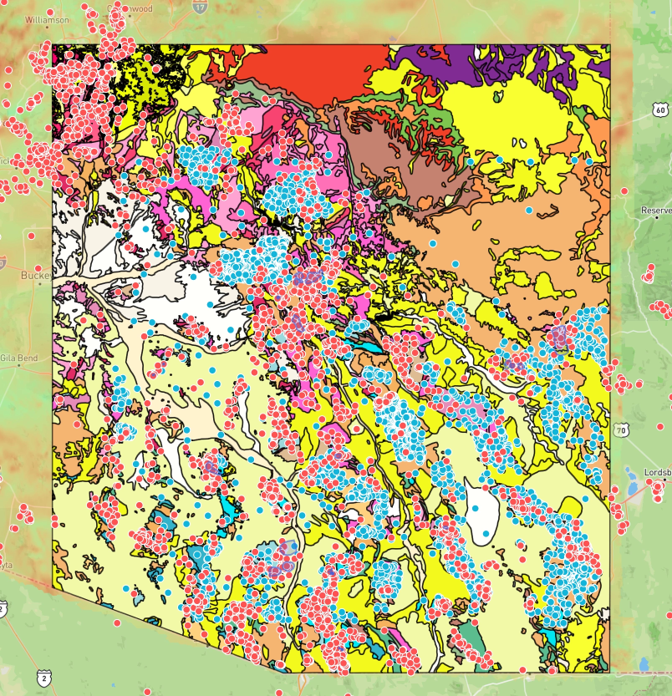
Each dataset carries provenance, version tags, and spatial bounds, so any target can be traced back to the evidence that produced it. All 25 layers stack in a single map workspace with per-layer styling, opacity, and color controls. An explorer can overlay aeromagnetics on alteration indices on known deposits and read the relationships directly.
What the Model Found
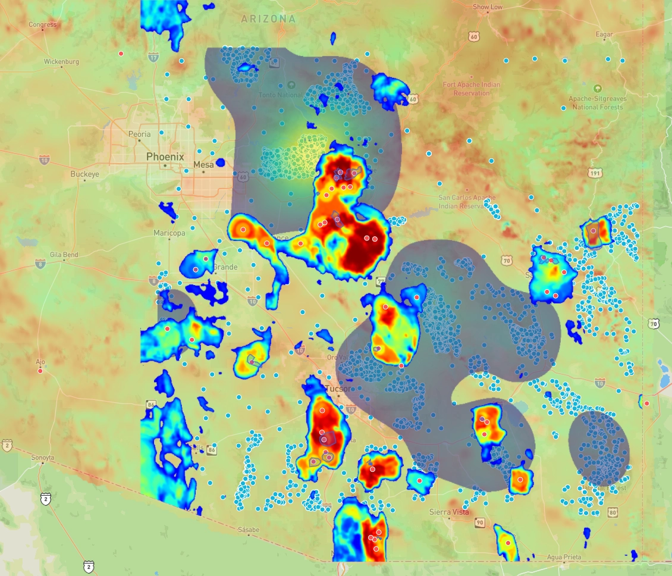
The real test of a prospectivity model is whether it independently re-discovers known deposits. Every annotated mine in the AOI falls inside the model's high-prospectivity zones, without those mine locations ever being used as training targets.
The validated set spans the full spectrum of the province:
• Resolution: ~1,770 Mt at 1.51% Cu, one of the largest undeveloped high-grade copper systems in the world. The model flags it strongly.
• Morenci: ~11,000 Mt, the largest copper operation in North America, in continuous production since the 1870s.
• Ray, Miami-Inspiration, Mission, Silver Bell: major mid-tier and historic systems across the province, all captured.
That a single model surface simultaneously captures a world-class undeveloped deposit, the continent's biggest producer, and a string of historic systems is the strongest possible demonstration.
Model Performance
Spatial cross-validation (4-fold, ~60 km buffer between folds) prevents the spatial autocorrelation shortcut that quietly inflates many prospectivity models.
ROC-AUC: Mean 0.80 across folds (range 0.68–0.96). Top 10% of ranked ground captures ~38% of known deposits on average, up to 93% in the best fold. That is a 5–30× lift over random selection.
Feature importance confirms the model is learning porphyry first principles:
Copper-molybdenum geochemistry plus the gravity expression of buried intrusions carry most of the signal, exactly what a porphyry geologist would weight. The model independently rediscovered the exploration logic.
The Takeaway
In a single project, MinersAI took 25 public datasets across five disciplines and turned them into a ranked, uncertainty-aware copper prospectivity map (validated against 49 known porphyry systems and ~41 Gt of documented ore) over 110,000 km², with no manual data wrangling and no local GIS stack.
The platform compresses months of multi-disciplinary data assembly and modeling into a reproducible, shareable, map-first workflow. The inputs, outputs, validation evidence, and interpretation stay connected, so the next geologist who opens the project can pick up exactly where this one left off.