
Article
Resourcing Tomorrow 2025: My takeaways from a sector on the edge of reinvention
February 17, 2026
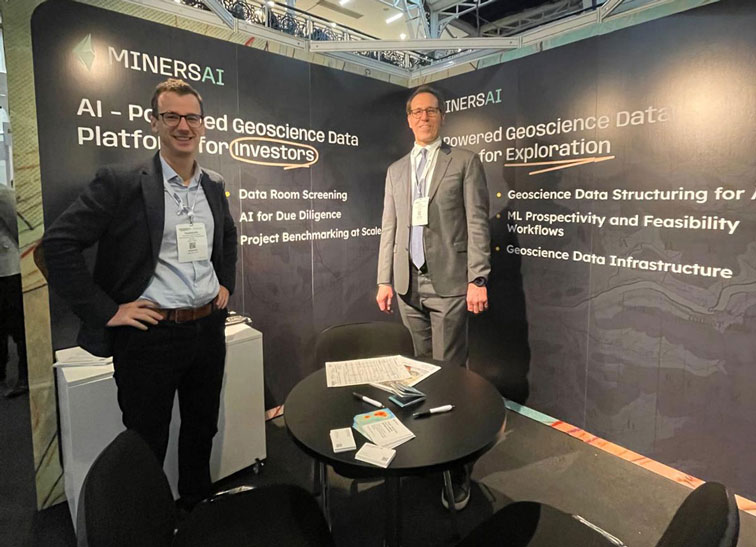
Last week at Resourcing Tomorrow in London, I spent three days speaking with miners, investors, governments, founders, and anyone brave enough to explore how AI might transform one of the world’s most complex industries. The conversations were energising, but they also revealed a very real truth: innovation in mining is happening, but it still fights against gravity. Here are the takeaways that stuck with me, and the ones shaping what we’re building at MinersAI. By Tomi de Lophem, CEO and co-founder of MinersAI.
1. Pilots are essential, and incredibly hard to land
Everyone agrees pilots are the gateway for bringing new technology into mining operations. But the risk aversion is real, and it’s justified. When operations are measured in millions per day, trying something new isn’t a casual decision.
Innovation departments can help open the door, but they often lack the authority to push solutions through to operations. The real challenge is enabling risk-controlled experimentation inside the operational environment itself, not on the sidelines.
This is where initiatives like the Creative Destruction Lab, NewLab or Rethink Mining deserve credit. They’re actively bridging this gap.
2.Countries are racing to modernise, fast
Saudi Arabia gets the headlines, but the strongest interest I saw came from Central Asia: Kazakhstan, Turkmenistan, Uzbekistan, Mongolia. These countries know they’re sitting on critical resources and want to position themselves as modern mining hubs.
The level of inbound we saw from them at the event confirmed this trend loud and clear.
3. Data is still the bottleneck, and AI pilots fail because they start with the wrong question
This shouldn’t surprise anyone, mining is only as good as its data. Structuring remains a persistent bottleneck.
But the bigger issue is this: too many AI pilots start with “let’s try AI” rather than “let’s solve a real operational problem.”
The result? The majority never scale. Not because AI isn’t valuable, but because the problem definition wasn’t valuable enough.
For us at MinersAI, this reinforces a core belief: start with the bottleneck, not the algorithm. Solve something real or don’t bother.
4. Mining problems are not “vibe codable”
In a world where people brag about building software in a weekend using AI, it’s worth stating the obvious: mining is different.
You can’t “vibe code” geoscience, exploration workflows, or data conditioning. These are deep, scientific problems. They can’t be solved by throwing generic models at messy data and hoping for the best. And that’s good news because the companies willing to do the hard work will create the lasting value.
5. The industry has more data than ever, and no capacity to analyse it
One misconception I had before this event was that mining suffers from a lack of data. Actually, in many cases, the oppositeis true. Companies have too much data to analyse manually, even when it’s well-structured.
This only strengthens the case for machine learning, but again, only when the problem is sharply defined.
6. The opportunity ahead: automate the hardest part first
Every conversation reinforced the same point. If we want to accelerate innovation in mining, we must start with the foundation, automating data structuring.
That’s why our focus is clear - building AI data structuring pipelines that save up to 90% of the data crunching time for all the geoscientists.